


A warm cover, a buzzing switch, or a breaker that will not stay on is the house showing you where the fault is. Shut that circuit off. Do not open the device to look, and do not put in a larger breaker to stop the trips.
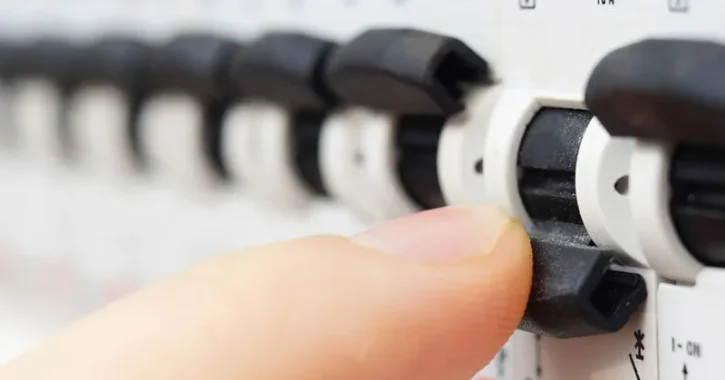
The photo is a finger on a breaker toggle. Switching the breaker off is the step a homeowner can take. Opening the panel and pulling breakers out is not.
A warm outlet or a burning smell
An outlet should feel cool. Heat means a loose screw, a backstabbed wire, or a circuit carrying more than it should. A burning smell means the insulation has already been hot. Unplug the cords, switch the breaker off, and leave it off.
A non-contact tester is only a first check from outside the box. A beep means voltage is likely present. Silence does not prove the circuit is dead. Leave the cover on. A hot outlet is already a failed connection.
If the cover was warm only while a heater ran, and it cools after you unplug it, the load may be the cause. A 15-amp circuit is limited to 12 amps when the load runs for three hours or more. A 1,500-watt heater at 120 volts draws 12.5 amps. That is already over the limit. Those are overloaded circuits.
A switch plate that buzzes or feels warm, with a cool outlet beside it, is a switch fault. That is a light switch that buzzes or feels hot. Lights that flash on and off point to a loose connection on that circuit. A room that dims when the air conditioner starts is usually a heavy load on a shared circuit.
A larger breaker is not a repair
When a breaker trips, it is opening because the wire or the device is past a safe load. Leave it off. The wrong fix is a bigger breaker. Copper 14 gauge wire is limited to a 15-amp breaker. Copper 12 gauge wire is limited to a 20-amp breaker. A 20-amp breaker on 14 gauge wire does not add capacity. It lets the wire overheat before the breaker opens.
A tandem breaker is a different device. It puts two circuits in one panel space. Each side still protects its own wire at that breaker’s rating. A tandem does not, by itself, leave the branch wire unprotected. Tandems become a problem when they are added to invent space in a full panel, or when the breaker is not listed for that panel. A breaker has to be listed for the panel it sits in. Circuit breakers that trip again should stay off until the circuit is checked.
Aluminum branch wire
Some Chicago homes from the 1960s and 1970s have aluminum branch circuits, often 10 or 12 gauge, on outlets and switches. Aluminum fails at the device and at the lug, not in the middle of a straight run. Antioxidant paste is not the repair. A copper tail on the old screws is not the repair either, unless the connector is listed for aluminum. The connection is remade during aluminum wiring repair.
Aluminum cable at the meter is a different product. It is a normal service material when the lugs are listed for it. A warm bedroom outlet is not a reason to replace the service cable.
Knob-and-tube and cloth-covered wire
Knob-and-tube wiring is an open method with no equipment ground. The splices were meant to stay in free air. Insulation that gets buried, or foam sprayed over the runs, takes away the air those wires need. Scorched covers, blown fuses, or a burning smell in a house of that age call for a look at the old wiring, not a new faceplate.
Cloth-covered cable is a later method. The braid dries, cracks, and can leave conductor exposed. Cloth wiring is a separate question from knob-and-tube, and the two are not repaired the same way.
Panels that fail to trip
Federal Pacific Stab-Lok and Zinsco breakers have a record of failing to trip. Age alone does not make a panel unsafe. Those two product lines do. A replacement breaker has to be listed for that panel. A panel that buzzes, or a breaker handle that is warm, means leave the cover on. A panel that buzzes is not a loose door screw to ignore.
A 60-amp service is often too small once a house has central air, an electric range, and a dryer. A 100-amp service still runs many Chicago homes. It is too small only when a load calculation says the next circuit will not fit. That shows up after an EV charger, a new air conditioner, or a kitchen that needs more circuits. An electrical service upgrade follows that calculation. It is not an automatic change to 200 amps.
Wet rooms and outdoor outlets
Kitchens, baths, garages, basements, and outdoor boxes need GFCI protection. An outdoor outlet also needs a weather-resistant device and an in-use cover where a cord stays plugged in. Rust on the screws, a trip after rain, or a dead yard light means water reached the box. A new cover on the same indoor device does not fix that.
A two-prong outlet means there is no equipment ground in that box. Where no ground wire is present, the repair is a GFCI device marked No Equipment Ground. Downstream three-prong outlets are marked GFCI Protected. A jumper from the neutral to the ground screw is not a ground. Two-prong outlet replacement is that job, not a cosmetic swap of the faceplate.
When to call
Call the same day if an outlet is too hot to keep your hand near, if you smell burning, or if a breaker trips every time that wall is used. STS Electric serves Chicago and Cook County at (773) 721-1111, day and night.
On a repair visit we replace the failed device, land the wires under the screws, and check whether the circuit is overloaded or the wire itself is damaged. Aluminum connections are remade with a listed connector. A panel at that cannot take another circuit is a service conversation. Start with electrical repair service when the outlet, the switch, or the breaker is the part that failed.
Questions we hear on these calls
Can I test a hot outlet with a plug-in tester?
No. Unplug the cords, switch the breaker off, and leave the cover on. A plug-in tester cannot see a loose wire behind the device, and a quiet non-contact tester does not prove the circuit is dead.
Will a new outlet stop the heat?
Sometimes the receptacle itself failed. Often the heat started at a loose wire or at too much load on that circuit. The visit checks the rest of the circuit, not only the faceplate.
Does a 100-amp service have to be replaced?
No. Many Chicago homes run on 100 amps without trouble. Upgrade the service when a load calculation says the panel cannot take the next circuit, or when the panel is a Federal Pacific Stab-Lok or a Zinsco.


