


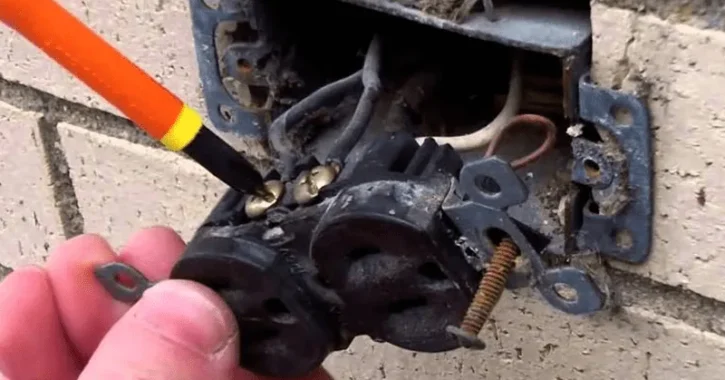
A wall outlet should feel cool. If the cover is warm, if the outlet buzzes, or if you smell hot plastic, stop using it. Do not press your hand on it to judge the heat, and do not pull the device out of the wall. Unplug what is connected, switch the breaker off, and leave that circuit off until a licensed electrician checks it.
The photo shows a burnt receptacle after it was taken out of the box. That is the end of the job, not the first step. A homeowner who opens a live outlet can be shocked and can make a loose connection worse.
A warm outlet and a hot outlet are not the same call. A cover that is slightly warm while a space heater or a window air conditioner is running, can mean the circuit is carrying too much current. An outlet that is hot with nothing plugged in, or hot enough that you pull your hand away, is a loose or damaged connection. That second case can start a fire inside the wall. Treat it as an emergency.
Why a hot outlet is dangerous
An outlet is built to pass current without making noticeable heat. Heat means electrical resistance at a point that should be a solid connection. A loose screw, a wire pushed into a backstab hole, or a conductor that is too small for the load turns part of the current into heat. The heat hardens the insulation, browns the faceplate, and can ignite the box or the wood around it.
Chicago brick two-flats and older bungalows often still have the original devices. Backstabbed wires loosen after years of warming and cooling. A kitchen outlet over a counter can look like a small annoyance until the plastic yellows or the breaker on that branch starts to trip.
Buzzing from the outlet is arcing. A burnt smell is insulation that has already been hot. Either one means the breaker stays off. Wiping the cover and plugging the cord back in does not fix the connection behind it.
Warm under a load, or hot with nothing plugged in
Notice the heat, then stop touching the cover. If a heavy appliance is running, unplug it and wait a few minutes. If the cover cools, the load was part of the problem and the circuit still needs a check before that appliance goes back on the same outlet. If the cover stays hot after the cord is out, the fault is in the device or in the wiring in the box.
A 15-amp circuit is limited to 12 amps when the load runs for three hours or more. A 1,500-watt heater at 120 volts draws 12.5 amps. That is already over the continuous limit, and the outlet is often where the heat shows first. A microwave, a toaster, and a coffee maker on one kitchen branch do the same thing in shorter bursts. Those are signs of an overloaded circuit. The repair is to move the load onto a circuit that can carry it. Resetting the breaker and leaving it does not remove the heat.
Loose and backstabbed connections
Many receptacles have holes in the back that grab the wire with a spring. Those backstabbed connections loosen. Each time the loose metal arcs, the terminal gets hotter. You feel that heat on the cover long before the faceplate cracks. Worn plugs, a device that was replaced in a hurry, and screws that were never tightened do the same thing at the side terminals.
The repair is a new receptacle with the wires under the screws, tightened to the device listing. That work happens only after the circuit is proved dead. It is not a job to try with the breaker mostly off.
Overloaded circuits
Space heaters, window air conditioners, hair dryers, and kitchen appliances are the loads that cook a tired outlet. A 15-amp branch was never meant to run a 1,500-watt heater for hours. If the breaker trips every time that wall is used, switch it off and leave it off. A breaker that trips is doing the job the outlet can no longer do safely.
Several outlets on the same circuit running warm means the heat is not one bad device. The branch is carrying too much, or a loose splice is shared by those boxes. A power strip does not add capacity. It adds more plugs to the same wire.
A failing device or a damaged cord
A cracked receptacle, a plug with burn marks, or an appliance that smells hot can heat the outlet even when the house cable is sound. Unplug everything on that circuit, including lamps in other rooms if they go dead with the same breaker. If the outlet is still hot with every cord removed, stop there. The branch needs an electrician. Do not take the cover off to keep testing cords.
The wrong receptacle on that circuit
A 20-amp circuit that feeds two or more receptacles can use standard 15-amp outlets. One receptacle by itself on a 20-amp circuit has to be a 20-amp device. A worn 15-amp outlet used as the only plug for a heavy cord, or a loose device left on a circuit that now feeds a heater, is a common reason the cover runs hot. Old replacements show up often on these calls. The outlet is a failed connection. Keep using it and the damage moves into the wire.
Aluminum branch wire
Some Chicago homes wired in the 1960s and 1970s have aluminum branch circuits, often 10 or 12 gauge, feeding outlets and switches. Aluminum fails at devices and at lugs, not in the middle of a straight run. Antioxidant paste on the old screws is not the repair. The connection has to be remade with a connector listed for aluminum during aluminum wiring repair.
Aluminum service cable at the meter is a different product. It is a normal service material when the lugs are listed for it. A warm bedroom outlet is not a reason to replace the service cable, and a service upgrade does not by our self fix an aluminum device on a branch circuit.
What to do when an outlet feels hot
Stop using the outlet. Unplug every cord fed from that breaker. At the panel, switch the breaker off. Do not reset a breaker that keeps tripping and then leave for the day.
If you smell burning, if the cover is brown or black, or if the outlet is too hot to keep your hand near, leave the breaker off and call. That includes nights and weekends.
Leave the cover on. Do not tighten screws and do not pull the receptacle out to look. An electrician proves the circuit is dead with a contact tester before a terminal is touched. A non-contact tester is only a first check from outside the box. A beep means voltage is likely present. Silence does not prove the circuit is dead. A low battery, a metal box, or the way the tester is held can hide voltage. A quiet tester is not a reason to open the outlet.
A hot light switch is a different fault. If the switch plate buzzes or feels warm and the outlet beside it is cool, the problem is a light switch that buzzes or feels hot. Leave the outlet alone.
When to call STS Electric
Call if one outlet is too hot to keep your hand near, if several outlets on one circuit run warm, or if the breaker trips as soon as that wall is used. STS Electric serves Chicago and Cook County at (773) 721-1111, day and night.
On a repair visit we replace the failed device, land the wires under the screws, and check whether the branch is only overloaded or needs a new circuit. If the wiring is aluminum, the connection is remade with a listed connector. If the panel cannot take another circuit, that is a service conversation, not a new faceplate.
Start with our electrical repair service for a hot outlet. If the only symptom is a switch that buzzes or runs warm, the switch is the part that failed, not the outlet.


